
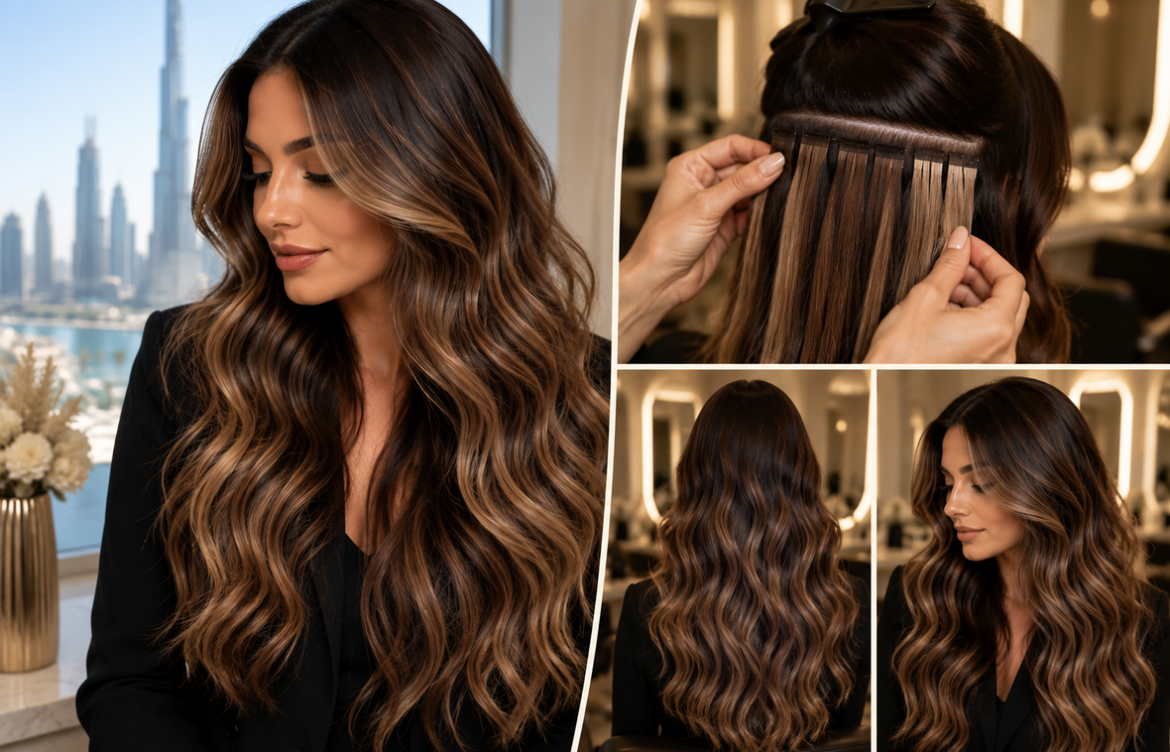
Are Natural Hair Extensions Worth It for Everyday Wear in Dubai?
If you have ever sat in a salon chair in Dubai and wondered whether extensions are a practical everyday option or just a special occasion splurge — you are not alone. It is one of the most common questions that comes up during consultations, and the honest answer is: it depends entirely on which method you choose, how your hair is maintained, and whether your lifestyle actually suits them.
Extensions have come a long way. The heavy, obviously fake sets that used to slip out at the worst moments are not what most reputable Dubai salons are offering anymore. Today’s natural hair extensions, when applied correctly, are lightweight, virtually undetectable, and genuinely designed for daily wear. For many women here, they have become as routine as a blowout.
But Dubai is not a forgiving environment for hair — and that matters before you commit.
Why More Women in Dubai Are Choosing Natural Hair Extensions
Dubai’s social calendar does not slow down. Between work, Friday brunches, evening events, and everything in between, women here want hair that looks polished consistently — not just on the days they have time to style it properly.
Extensions solve a real problem. Rather than spending 45 minutes with a curling iron every morning trying to create volume that simply is not there, women with extensions wake up to hair that already has shape and fullness. A quick brush, maybe a light wave, and they are done.
There is also the climate factor. Dubai’s dry air and constant air conditioning strip moisture from hair faster than most people realize. Thinner or finer hair often looks flat and lifeless by midday. Extensions add density that holds up better throughout the day, even when the hair itself has lost some of its body.
For most clients, it is not about dramatic transformation. It is about not having to think about their hair so much.
Do Hair Extensions Feel Comfortable for Daily Wear?
This is the fear that stops most first-timers. The idea of something attached to your scalp all day sounds uncomfortable before you have experienced it.
Professionally applied extensions should not hurt. Full stop. If they do — if there is pulling, soreness, or tension after the first couple of days — something has been applied incorrectly and needs to be looked at immediately.
For most women, the first week involves a small adjustment period. You notice them when you sleep, when you brush, when you tie your hair up. By week two, the majority of clients forget they have them in.
The method matters significantly. In Dubai’s climate, tape-in extensions tend to work exceptionally well for fine to medium hair because they lie completely flat against the scalp, distribute weight evenly, and do not create visible lines. Keratin bond extensions suit thicker hair better and offer more movement. Clip-ins are the right choice if you want extensions only for events rather than every day.
No single method suits everyone. A proper consultation — not just a quick look and a quote — is what separates a comfortable result from one you regret.
How Dubai’s Climate Affects Hair Extensions
Between April and October, Dubai throws everything at your hair: 45-degree heat, humidity that spikes without warning, chlorinated pools, saltwater beaches, and indoor air conditioning cold enough to dry out your scalp in an afternoon.
Synthetic extensions simply cannot handle this environment. They frizz in humidity, refuse to blend after heat styling, and deteriorate quickly under UV exposure. This is why natural human hair extensions are the only option worth considering for everyday wear here — they respond to heat tools the same way your own hair does, they blend naturally, and they age far more gracefully in the conditions Dubai creates.
Even natural extensions need extra attention in summer. Dryness is the biggest enemy. Extensions do not receive natural oils from the scalp the way your real hair does, so they dehydrate faster in heat. Weekly hydration masks are not optional during the warmer months — they are maintenance. Women who swim regularly need to rinse extensions immediately after pool or sea exposure and apply a leave-in conditioner before the hair dries out.
If you are not willing to do that, extensions will tangle, matt, and feel rough within a few months. If you are, they can look great for six months or more.
Are Natural Hair Extensions High Maintenance?
Compared to natural hair? Yes, slightly. Compared to the time most women already spend styling, straightening, and trying to create volume that is not there? Often less.
Daily care is straightforward: brush from ends to roots with a soft-bristle extension brush before bed, sleep with hair loosely braided or tied, and do not go to bed with wet extensions. Wet hair that tangles overnight is the fastest way to damage both the bonds and your natural hair underneath.
Washing is where most new extension wearers make mistakes. Extensions should be washed less frequently than natural hair — two to three times a week maximum — and always with sulfate-free products. Sulfates break down the bonds faster and strip the hair of the moisture it is already struggling to hold on to.
Salon visits for maintenance depend on the method. Tape-ins typically need repositioning every six to eight weeks as the natural hair grows. Keratin bonds last slightly longer. Missing these appointments does not just affect how extensions look — it affects the health of the natural hair growing underneath them.
Who Benefits Most from Hair Extensions?
Women with fine or thin hair see the most dramatic difference. Not because the transformation is extreme, but because the problem extensions solve — lack of volume and density — is the exact thing fine hair struggles with every single day.
Women recovering from postpartum hair loss or stress-related shedding also find extensions genuinely helpful during the growth phase. They add coverage, restore the appearance of fullness, and remove the daily frustration of working with hair that feels like it is disappearing.
For women who already have a reasonably full head of hair, extensions are usually about length and styling flexibility — fuller ponytails, longer braids, better movement in waves and curls.
What extensions are not ideal for: women with very damaged or heavily bleached hair who skip the repair work first. Applying extensions to already fragile hair puts additional stress on strands that cannot handle it. A bonding or strengthening treatment before installation is not an upsell — it genuinely matters for the long-term result.
Can Hair Extensions Damage Natural Hair?
Extensions applied by an experienced professional, matched correctly to your hair density, and maintained properly do not damage natural hair. That sentence has a lot of conditions in it — because when any one of those things goes wrong, damage becomes a real risk.
The most common cause of extension-related damage is not the extensions themselves. It is tension. Too much weight on a thin section of hair, bonds applied too close to the root, or tape that has not been repositioned on time — all of these place stress on the follicle over weeks and months. The damage usually shows up as breakage along the hairline or at the nape, which takes time to recover from.
The second most common cause is improper removal. Extensions should always be removed professionally. Attempting to pull or slide them out without the correct products and technique tears the natural hair. This is not a grey area.
Go to a salon with a genuine track record in extension work. Ask to see before and after photos. Ask how they handle removal. If the consultation is rushed or the questions are brushed off, that tells you something important.
Styling Benefits of Natural Hair Extensions
Once you have had a good set of extensions for a few weeks, the styling benefits become obvious in ways that are hard to describe until you experience them.
Curls hold longer because there is more hair to hold them. Ponytails look full instead of wispy. Blowouts have shape that lasts two days instead of disappearing by afternoon. Even just wearing hair down looks more intentional because the added density creates natural movement.
For women attending frequent events in Dubai — and the social calendar here rarely has a slow week — this translates to fewer rushed morning styling sessions and fewer emergency salon appointments before important occasions.
Choosing Extensions That Still Look Natural
The best extensions are the ones nobody comments on. Not because the result is unimpressive, but because it looks like your hair.
Modern extension techniques are built around blending — matching not just the color but the texture, the way light hits the hair, and the density at different sections of the head. A good colorist will match extensions to your balayage or highlights, not just your base color. That detail makes the difference between hair that looks seamlessly full and hair that looks like it has layers that do not quite belong.
The trend in Dubai has moved toward natural volume over dramatic length. Clients who once asked for 24-inch extensions are now asking for 16 or 18 inches that blend completely with their own length and move the way real hair moves. The goal has shifted from noticeable to effortless — and that is the right direction.
Frequently Asked Questions
Are natural hair extensions suitable for everyday wear?
Yes — when applied correctly and maintained properly, natural hair extensions are genuinely designed for daily wear. The right method for your hair type and lifestyle makes all the difference in how comfortable and practical they feel long term.
Do hair extensions get damaged in Dubai weather?
They can if they are not maintained properly. Heat and humidity accelerate dryness, and saltwater or chlorine exposure without immediate rinsing causes tangling. Regular hydration, sulfate-free products, and prompt post-swim care keep extensions in good condition through Dubai’s harsher months.
Which hair extensions look the most natural?
Human hair extensions that are professionally color-matched to your specific shade — including any highlights or balayage — create the most seamless result. The texture match matters just as much as the color.
Can natural hair extensions damage your real hair?
Incorrectly applied extensions, too much weight on fine sections, or delayed maintenance appointments can all cause breakage over time. Professional installation and consistent upkeep are what protect the natural hair underneath.
Are hair extensions high maintenance?
They require a specific routine — less frequent washing, regular brushing, proper drying, and scheduled salon visits for repositioning. Most women adjust to this within a few weeks and find it manageable alongside their existing beauty routine.
Final Thoughts
Natural hair extensions are worth it for everyday wear in Dubai — but only when the decision is made with a clear understanding of the commitment involved. They are not a wash-and-forget solution. They reward the women who maintain them properly with consistently full, polished hair that genuinely simplifies daily styling.
In a city where the heat is relentless and the expectations around grooming are high, finding a solution that works with your lifestyle rather than adding to it is the whole point. For many women in Dubai, a well-applied set of extensions does exactly that.